
Maharashtra Chief Minister Devendra Fadnavis announced the state government's intention to introduce strong provisions to deal with religious conversions done using force or cheating. A panel has submitted recommendations, and the government will study and implement necessary changes. The move comes amid claims of misuse of religious freedom and concerns about conversions through coercion and deceit.

The Supreme Court has put on hold several key provisions of the Waqf (Amendment) Act, 2025, including the clause that only those practicing Islam for the last five years can dedicate a property as Waqf. The court also addressed the powers of collectors and non-Muslim participation in Waqf Boards.

BJP-ruled states argued in the Supreme Court that governors and the President have autonomy in assenting to bills passed by state assemblies, asserting that courts cannot mandate assent.

India is working with Yemeni authorities and friendly nations to find a solution for Nimisha Priya, the Indian nurse sentenced to death in Yemen for murder. The government is seeking more time for Priya's family to reach an understanding with the victim's family.

In a further setback to deposed All India Anna Dravida Munnetra Kazhagam leader O Panneerselvam, the Madras high court on Friday dismissed his appeals against the 2022 general council meet of the party, which among others had elected his rival Edappadi K Palaniswami as interim chief, besides expelling OPS and his aides.
The Supreme Court has directed authorities in Delhi-NCR to relocate stray dogs to shelters, emphasizing public safety and addressing concerns about dog bites, particularly among vulnerable populations.

The execution of Nimisha Priya, an Indian nurse on death row in Yemen, has been postponed by Yemeni authorities, sources said on Tuesday.

The matter would be heard by Chief Justice B R Gavai and Justice Augustine George Masih.

'Saudi-Pak defence pact is to anchor the defence and security of Saudi Arabia and not Pakistan, per se, with Islamabad being the junior partner.'

'However, we must implement a tit-for-tat approach -- reciprocating their conduct with precision.' 'If they demonstrate respect, we respond accordingly. If they adopt hostile positions, we mirror that hostility with equal intensity.'

The protesters shouted slogans such as KP Chor, Desh Chhod (K P Sharma Oli is a thief, quit the country), "Take action against corrupt leaders".

President Droupadi Murmu has exercised powers under Article 143(1) used in rarity to know from the Supreme Court whether timelines could be imposed by judicial orders for exercise of discretion by President while dealing with the bills passed by state assemblies.
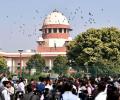
"The prejudice against Urdu stems from the misconception that Urdu is alien to India. This opinion, we are afraid, is incorrect as Urdu, like Marathi and Hindi, is an Indo-Aryan language. It is a language which was born in this land," the judges said.
According to a statement issued by the Grand Mufti's office, the decision was made after a high-level meeting held in Yemen's capital, Sanaa, where it was decided to completely cancel the death sentence, which had been temporarily suspended earlier.

The Grand Mufti said that in Islam, there is a law which allows the victim's family to pardon the murderer.
Last-minute efforts are underway to halt the scheduled execution of an Indian nurse in Yemen, with a Sufi scholar leading negotiations with the victim's family.

As soon as one of the pleas came up for hearing on Friday, Solicitor General Tushar Mehta, appearing for the Centre, objected and said there can't be an "endless" filing of pleas challenging the Act.

The Supreme Court on Thursday refused to examine a public interest litigation (PIL) seeking a judicial probe into the April 22 Pahalgam terror attack in which 26 people were killed.
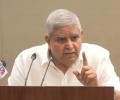
Rajya Sabha member Kapil Sibal has criticised Vice President Jagdeep Dhankhar for questioning the judiciary over the timeline for the president to take decisions, calling it "unconstitutional " and a lowering of the dignity of the chair. Sibal asserted that Dhankhar's remarks are not neutral and amount to an attack on the judiciary by the executive. He also pointed out that the president acts on the aid and advice of the council of ministers, and therefore, the president's power cannot be curtailed. Sibal urged Dhankhar to seek a review of the judiciary's decision or an advisory opinion from the Supreme Court if he has problems with it. He also questioned why Dhankhar only focuses on actions taken during Congress governments and not after 2014.
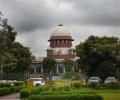
The Supreme Court of India has sought responses from the Centre and others on a petition challenging the constitutional validity of certain provisions of the Waqf Act, 1995. The petition argues that the Act gives undue favor to waqf properties and deprives non-Muslims of their property rights. The court has tagged the petition with pending petitions that raise similar issues.

Confirming the development, Leader of Opposition in the legislative council Ambadas Danve of the Shiv Sena-Uddhav Balasaheb Thackeray said the boycott is a mark of protest against a "dishonest government".

Russian President Vladimir Putin on Monday assured Tehran of Moscow's support in de-escalating the Israel-Iran conflict hours after the United States strikes at Iranian nuclear sites at dawn on Sunday.

The Supreme Court expressed its disapproval of an analogy used by the Centre in support of the inclusion of non-Muslims in Waqf boards, stating that such logic would disqualify a bench of Hindu judges from hearing matters related to Waqf. The CJI questioned the Centre's stance on the provisions of the Waqf (Amendment) Act, 2025, which allows non-Muslim members in the Central Waqf Council and state waqf boards. The Solicitor General defended the provisions, emphasizing that the non-Muslim inclusion is limited and does not impact the Muslim composition of these bodies. However, the CJI asserted that judges shed their religious affiliations while serving on the bench and maintained their secularity in their judicial capacity.
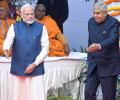
The RSS which catapulted Jagdeep Dhankar to national prominence after 21 years of hibernation could not come to his rescue when BJP higher ups decided to seek his resignation, points out Prakash Bhandari.
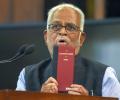
'Earlier, we used to talk about a deficit economy. There is a deficit in democracy' 'If you read superficially Gandhi and Ambedkar and Nehru, some misconceptions and misunderstanding come to mind, as if they were at loggerheads and they differed radically in their views' 'India is one nation. There is only one citizenship. No citizenship for South India and no citizenship for North India and another for the Northeast'
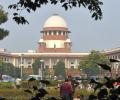
The Supreme Court on Monday said the pleas challenging the Waqf (Amendment) Act's constitutional validity will now be taken up by a bench headed by Chief Justice of India-designate Justice B R Gavai on May 15 as the incumbent CJI will be demitting office on May 13.

The Supreme Court of India began hearing a batch of petitions challenging the constitutional validity of the Waqf (Amendment) Act, 2025. The bench, led by Chief Justice Sanjiv Khanna, asked both sides to address whether the court should entertain the petitions or relegate them to the high court. The hearing is underway with senior advocate Kapil Sibal arguing for the petitioners. The act, which was passed by Parliament following heated debates, has been challenged by various parties including AIMIM leader Asaduddin Owaisi, All India Muslim Personal Law Board (AIMPLB), and Jamiat Ulama-i-Hind.

Kuwait has executed 25 Indian nationals in the past five years.

Several opposition MPs, who had previously criticized former Rajya Sabha chairman Jagdeep Dhankhar, are now praising him following his sudden resignation, with some even requesting him to reconsider.

The Supreme Court dismissed Allahabad High Court judge Yashwant Varma's plea seeking invalidation of a report that found him guilty of misconduct in the cash discovery row.

A bench of Justices Surya Kant and N Kotiswar Singh was acting on a batch of pleas against the blanket ban on blood donations by such persons from the LGBTQIA+ community.

Chief Justice of India B R Gavai on Sunday expressed his displeasure over the absence of Maharashtra's Chief Secretary, Director General of Police or the city police commissioner to receive him during his first visit to the state after being elevated to the top post.

'Dialogue and discussion, not conflict, are the way forward.' 'Internal fighting strengthens our enemies and provides material to divide us.'

A bench comprising Chief Justice B R Gavai and Justice Augustine George Masih asked senior advocate Kapil Sibal, appearing for those challenging the validity of the law, and Solicitor General Tushar Mehta, representing the Centre, to file their written notes by Monday.
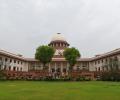
A Governor does not possess any discretion in exercise of functions under Article 200 of the Constitution in respect to any bill presented to them and must mandatorily abide by the advice tendered by the council of ministers, the Supreme Court has held.

Rajasthan Cricket Association official Jaideep Bihani has accused the Rajasthan Royals of match-fixing after they failed to chase down nine runs in the final over in their last two matches.
The Supreme Court of India has ruled that governors cannot indefinitely delay giving assent to bills passed by state legislatures, setting a timeline of one to three months for their actions. The court said the governor must act "as soon as possible" and that failure to comply with the timeline will make their inaction subject to judicial review. The ruling comes as several opposition-ruled states have accused governors of delaying assent to bills passed by their assemblies.
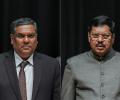
From demonetisation to sub-categorisation of Scheduled Castes to bulldozers, Justice Gavai has been part of several judgments.

Tamil Nadu Chief Minister M K Stalin has welcomed the Supreme Court's ruling that state governors must give assent to bills passed by state assemblies, calling it a 'historic' victory for all state governments in India. The court's decision came after the Governor of Tamil Nadu, R N Ravi, withheld assent to several bills passed by the state legislature. The court found that the governor's actions were in violation of the Indian Constitution, which mandates that governors must act on the advice of the council of ministers. The ruling is seen as a significant step towards strengthening the federal structure of India.

The Centre on Wednesday told the Supreme Court that nobody can claim right over government land and it is legally empowered to reclaim properties which are declared waqf by using the waqf by user principle.
